
Criminal Court Cases in Richmond County
Richmond County criminal court cases are divided by the level and stage of the charge. District Court hears misdemeanors and infractions. It also handles early felony steps, including qualifying first appearances and probable-cause matters, before a felony reaches Superior Court through indictment or another lawful transfer. Superior Court is the felony trial court. City ordinance and traffic charges also move through the state District Court system unless an active separate court is officially shown.
The Clerk of Superior Court keeps the files for both divisions at the Richmond County Judicial Center. The office name can cause confusion because the clerk is not limited to felony files. Richmond County case records for District Court and Superior Court, paper files, public terminals, copy requests, and certified county searches all run through that office. The official Richmond County courts page is the safest starting point for current calendars and service links.
Richmond Court Divisions by Charge
A court label says more than the word “criminal.” It shows where the prosecution stands and which judicial division controls the next step. Richmond County shares Prosecutorial District 21 with Anson and Scotland counties, so some prosecutor and calendar material is district-wide even though the Richmond case file stays with the local clerk.
| Court or office | Richmond County role | Phone |
|---|---|---|
| Superior Court | Felony trial court after indictment or transfer | Clerk 910-419-7400; judges 910-419-7686 |
| District Court | Misdemeanors, infractions, and early felony matters | Judges 910-419-7575 |
| Magistrates | Initial process and pretrial-release decisions | 910-419-7599 |
| District Attorney 21 | Prosecution of state criminal charges | 910-419-7500 |
The Judicial Branch contact directory displays those court contacts in one place.
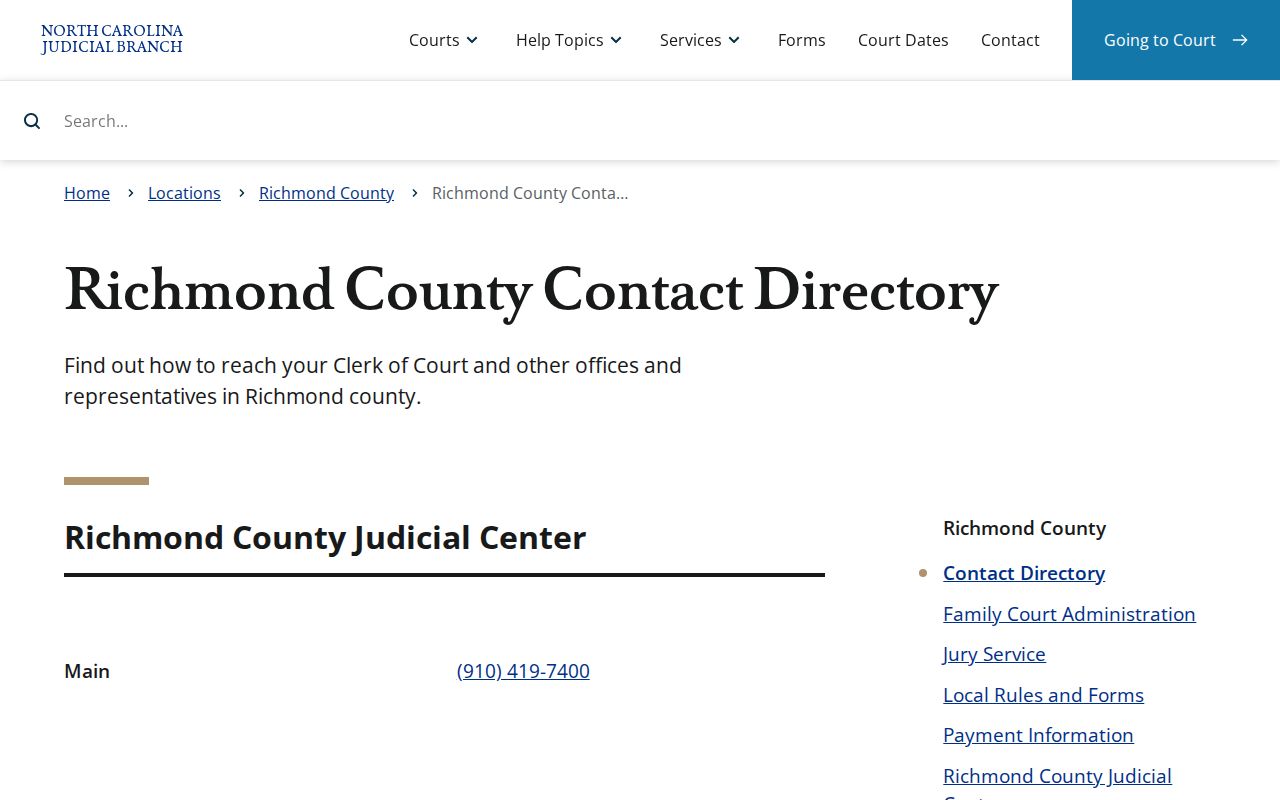
That directory helps route a Richmond County court question without treating the prosecutor, magistrate, and clerk as interchangeable record custodians.
Note: The Clerk of Superior Court title covers both District and Superior Court criminal files in Richmond County.
Richmond County Case Record Searches
The North Carolina eCourts Portal supplies near-real-time case summaries and registers of actions. A precise case number is the best key. When only a name is known, use Richmond County as the location and add a filing range or other lawful identity detail. A name match alone does not prove identity.
- Start at the official county court page, follow its Portal link, and enter the exact case number or party name.
- Narrow results by criminal category, case type, status, filing dates, and available party criteria.
- Open each possible case and compare identity details, events, hearings, and each charge disposition.
- Use the Richmond clerk’s terminal or request the paper file when Portal omits a document.
- Submit the official criminal-record form and $25 fee when a certified Richmond County result is needed.
The official Portal training resources explain Smart Search and its filters.
The training view is useful before reading a long Richmond County docket because it separates search controls from the events shown inside a case.
Smart Search Filters for Richmond Cases
Smart Search works statewide, so filters prevent a Richmond County court case lookup from mixing counties or similarly named parties. The system accepts party names or case numbers. Official wildcard rules require at least four case-number characters before an asterisk. A name wildcard uses at least three last-name characters and one first-name character before asterisks.
| Field | Type | Required | Use |
|---|---|---|---|
| Search text | Text | Yes | Party name or case number; wildcard supported |
| Location | Filter | No | Select Richmond County to narrow statewide results |
| Party criteria | Advanced filters | No | Name and date of birth where available |
| Case categories | Multi-select | No | Select Criminal Actions |
| Case type/status | Dropdowns | No | Narrow the kind and current state of a case |
| Filing dates | Date range | No | Limit the filing window |
Enterprise Justice numbers have a two-digit year, a letter case type, a six-digit sequence, and a three-digit county identifier. Do not assume the suffix in an official example belongs to Richmond County.
Note: A Portal event describes docket activity, while the disposition line states how a specific charge ended.
What a Criminal Case File Contains
A Richmond County case file is organized around a prosecution and its docket, not the arrest intake. Portal may show a useful summary, but it does not promise free access to every filed PDF. The clerk’s paper or electronic file is the source for an omitted pleading, order, or judgment.
| Case header | Case number, court and location, category, type, filed date, and status |
|---|---|
| Assignment | Judicial officer and department when those fields are populated |
| Parties | Names and roles, with protected identifiers withheld |
| Charges | Criminal allegations and separate dispositions where entered |
| Register of actions | Dated filings, hearings, outcomes, and other case events |
| Hearings | Date, time, courtroom, type, and judicial officer when scheduled |
| Financial entries | Public costs, fines, restitution, attorney fees, and payments when applicable |
| Documents | Available filings, with missing items requested from the clerk |
The court-record access page distinguishes Portal summaries, courthouse terminals, older paper files, and copies.
Those layers explain why an empty document link is not the same as an empty Richmond County case file.
Read Richmond Case Outcomes Carefully
The register of actions is a timeline. It may list filings, settings, continuances, hearings, and rulings, but an event is not automatically an outcome. A scheduled hearing is not proof it occurred. “Disposed” means the court reached an outcome, not that every count ended in conviction.
Read each Richmond County charge line. One prosecution can contain a dismissed count, a conviction on another count, and a judgment that applies only to part of the case. A disposition is the result of a charge. A nolle prosequi means the prosecutor chose not to proceed at that time. An acquittal is a not-guilty determination, while a dismissal ends a charge without a conviction. The actual judgment controls the sentence.
The Judicial Branch’s criminal case overview places these entries in the larger court process.
That state explanation gives context to docket terms without turning a single Portal event into a final legal conclusion.
Criminal Case Stages in Richmond County
A Richmond County prosecution may start with arrest, criminal summons, or other process. A magistrate handles initial process and release conditions. District Court addresses early proceedings. A felony then moves to Superior Court after indictment or another proper transfer, where arraignment, motions, plea or trial, judgment, and possible appeal follow.
Case flow: Charges Filed → Arraignment → Pretrial → Plea or Trial → Disposition → Sentencing
The sequence is a map, not a promise that every Richmond County case uses every step. A plea can end a case before trial. Charges may be amended or dismissed. Felony probable-cause proceedings may be waived, and a grand jury proceeding is secret. The docket and signed orders show what occurred in the specific prosecution.
Note: A felony may begin in District Court before indictment moves the prosecution into Superior Court.
Richmond Clerk Terminal and Certified Search
The clerk counter is the main fallback when online access is incomplete. Public self-service terminals at the Richmond County Judicial Center can search statewide criminal cases by defendant, case number, or victim or witness name. Paper case files are inspected in the county where the case is located. The Richmond clerk is at 105 W. Franklin Street, Rockingham, NC 28379, and the main number is 910-419-7400. Listed hours are 8:00 a.m. to 5:00 p.m. weekdays, excluding Judicial Branch holidays.
Bring a full legal name, approximate date of birth, and case number if known. Inspection is free. Copies cost extra, and the research does not confirm a current per-page or certification amount, so call before ordering. Check the Richmond County local rules and forms before a courthouse visit. The certified Richmond County criminal search costs $25 per name and covers this county rather than all North Carolina counties.
Richmond County Clerk
105 W. Franklin Street
Rockingham, NC 28379
910-419-7400
Weekdays, 8:00 a.m. to 5:00 p.m.
The official criminal search page explains certified and uncertified clerk options.
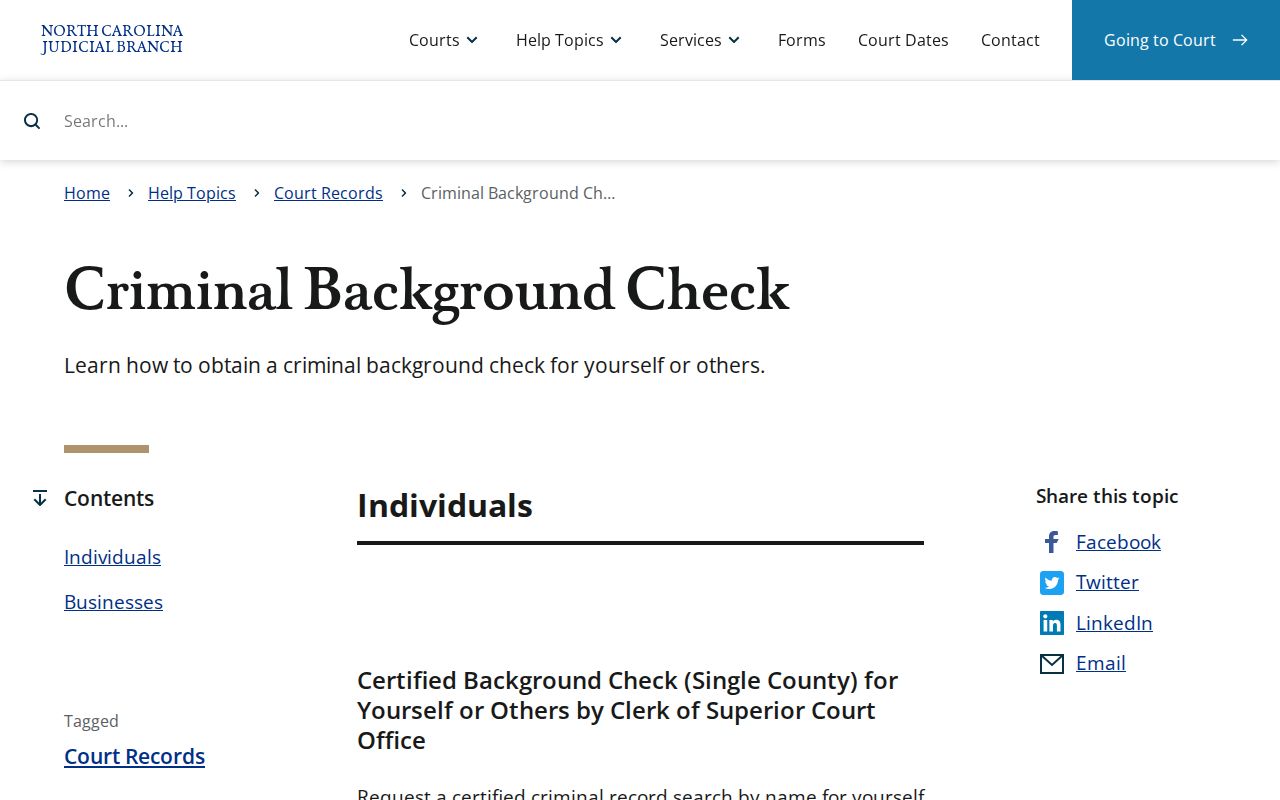
A certified search has a different purpose from the free Portal summary and must be requested through the clerk.
Richmond eCourts Conversion and Older Files
Richmond County joined eCourts on October 14, 2024, with the Track 6 rollout. North Carolina completed statewide Enterprise Justice use on October 13, 2025. The change made Smart Search locally relevant and created one statewide platform, yet it did not make every older paper or scanned document available online.
For a missing Richmond County entry, first check the spelling, county filter, filing range, and case type. Then use the public terminal. Ask the clerk to retrieve the paper file if the summary exists but a document does not. The Portal’s browser view works on mobile, though broad filters and long action registers are often easier to review on a larger screen. Search Hearings can locate schedules by case, party, attorney, judicial officer, or courtroom, but calendar information can change.
Note: Near-real-time access does not guarantee that each filed document, older record, or later correction is already visible online.
Access Rules for Case Records
G.S. 7A-109 requires clerks to make nonconfidential court records available under its terms. That rule does not erase limits on juvenile matters, confidential case types, protected victim or minor information, Social Security numbers, sealed files, or expunged records. Online views can redact more than the courthouse file, while some material remains closed in every channel.
If a public Richmond County case is not found, ask the clerk about the index and file rather than filing a broad administrative-record request. The Judicial Branch public-record request channel serves existing administrative records and is not a substitute for searching a court case file.
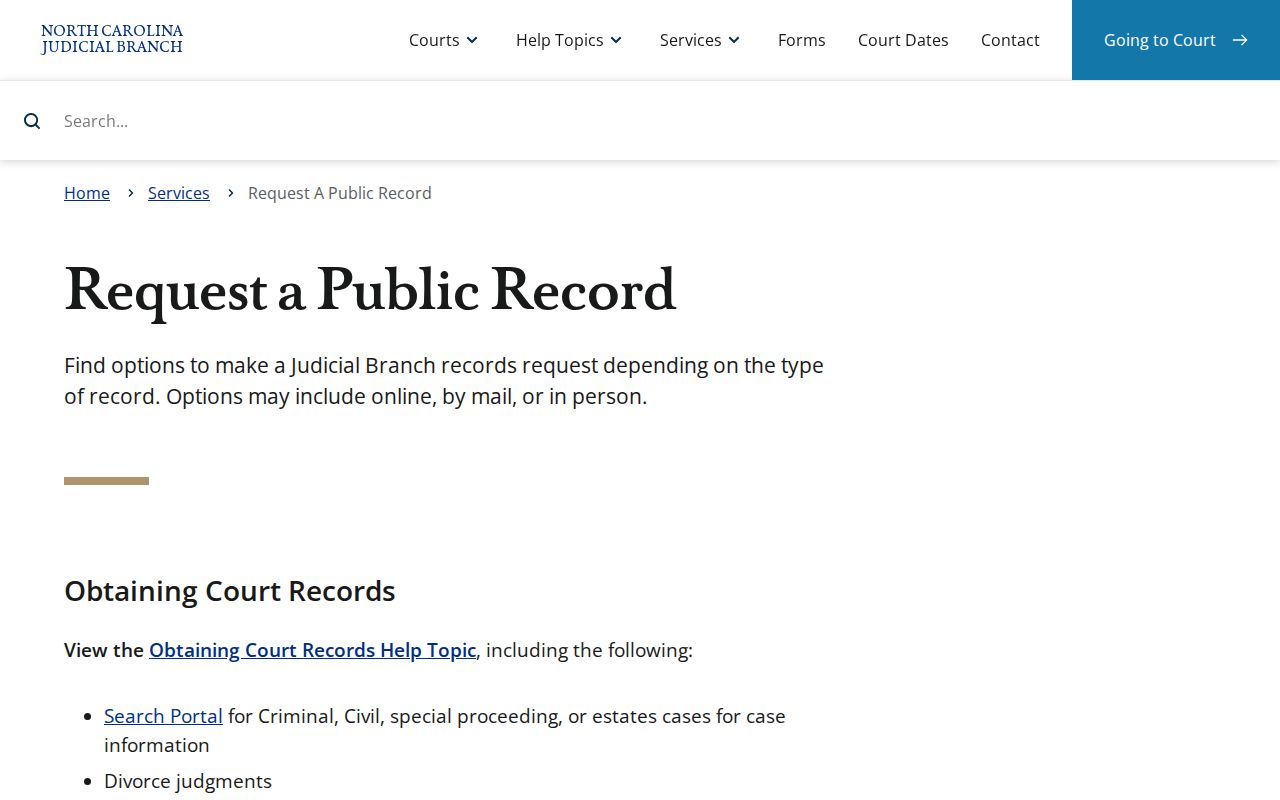
The distinction sends a case-specific request to the clerk while preserving the separate route for Judicial Branch administrative records.